PTFE and Silicone Rubber Coated Belting
Durable belts to keep your operation running smoothly
Taconic PTFE & Silicone Coated Conveyor Belts
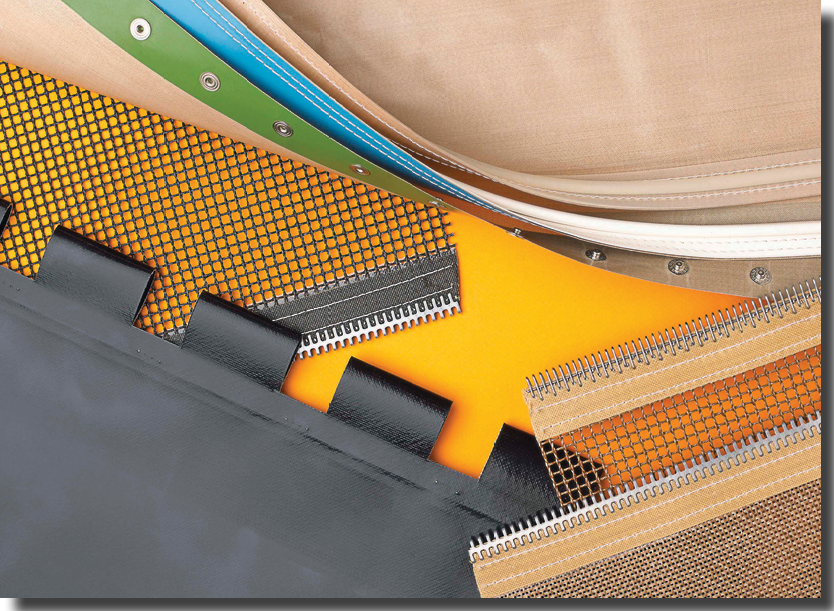
Fabric Grades for PTFE & Silicone Belts
Taconic offers multiple fabric grades to balance release, strength, flexibility, and cost for your specific belting application.
Premium
Premium grade fabrics have a heavy PTFE coating to provide the easiest release and the highest chemical resistance and electrical strength. Preferred for applications where fabric weave impression is undesirable and sticky materials are conveyed.
Standard
Standard grade offers a smooth surface with excellent nonstick properties. This grade is the most widely used PTFE glass belt for general purpose conveying and process applications.
Mechanical & Economy
Mechanical and economy grades feature a lighter PTFE coating that offers cost advantages in applications where increased surface texture is useful and maximum chemical resistance is not required.
Crease & Tear Resistant
Crease and tear resistant fabrics offer substantially higher tear strength for high speed applications. Ideal for belts that see frequent flexing, indexing, or impact at loading zones.
Anti Static / Conductive
Specially treated anti static and conductive fabrics reduce static build up on the belt surface. These belts are suited for applications where static control is important, including packaging of powders, films, and electronic components.
Silicone Rubber Coated Fiberglass
Silicone rubber coated fiberglass belts offer excellent release properties up to 500 °F (260 °C), superior abrasion, flex, and chemical resistance, and outstanding dielectric properties in demanding environments. Silicone belts are ideal where high flexibility and a high slip coefficient are required. Available coated on one or two sides in red or white.
Porous / Open Mesh
Porous and open mesh materials allow outgassing of volatile products and promote drying by allowing airflow through the belt. These belts are ideal for drying, curing, and bonding inks, pigments, and powders to fabrics and non woven materials.
Choosing the Right Belting Material
Key factors to consider when specifying PTFE or silicone coated belts for your process:
- Temperature Range – PTFE and silicone rubber coated belts can withstand continuous temperatures from -100 °F to 500 °F (-73 °C to 260 °C). Kevlar substrate products are suitable from -100 °F to 356 °F (-73 °C to 180 °C).
- Pliability – If the belt must track around drive and idler pulleys, pulley diameter is critical. The smaller the roller, the more flexible the belt must be. Taconic thinner materials (0.010" and under) are more pliable than heavier coated fabrics.
- Release Qualities – Belt surface finishes range from rough, semi porous textures to super smooth nonstick surfaces. Choose based on how easily you want the product to release.
- Strength – Consider breaking, tensile, and tear strength, as well as how heavy the load is, belt speed, and operating tension.
Fabrication Options
Taconic offers a full range of fabrication options to optimize belt tracking, longevity, and performance.
Click here to learn more about available splices, edge reinforcements, and tracking and guiding devices.
Ordering Your Taconic Belt
Please have the following information available when ordering:
- Dimensions of the belt (width and length)
- Desired splice, edge reinforcement, and tracking devices, where needed
- Pulley size and type
- Any special construction details or instructions concerning belt fabrication
In cases of complex fabrication, a print may be requested
Applications
Click here to learn more about the different applications for Taconic PTFE and silicone rubber coated belts.